
522 N New Ballas, Suite 163
St. Louis, MO 63141
Monday – Saturday
Sunday CLOSED
Book Now
314-942-1147
Email Us
522 N New Ballas, Suite 163
St. Louis, MO 63141
Monday – Saturday
Sunday CLOSED
Book Now
314-942-1147
Email Us
You’re sitting on the couch, nothing unusual happening, and suddenly your heart is pounding, your chest is tight, and your brain is screaming that something is wrong. But nothing is. That is the defining cruelty of a panic attack: your body is running a full emergency response for a threat that simply doesn’t exist.
Understanding the neuroscience behind this can genuinely make the next one less terrifying. Here’s exactly what happens in the brain during a panic attack, step by step. If these intense feelings start early in life or become frequent, exploring teen therapy support options can help build healthier coping patterns and emotional control over time.
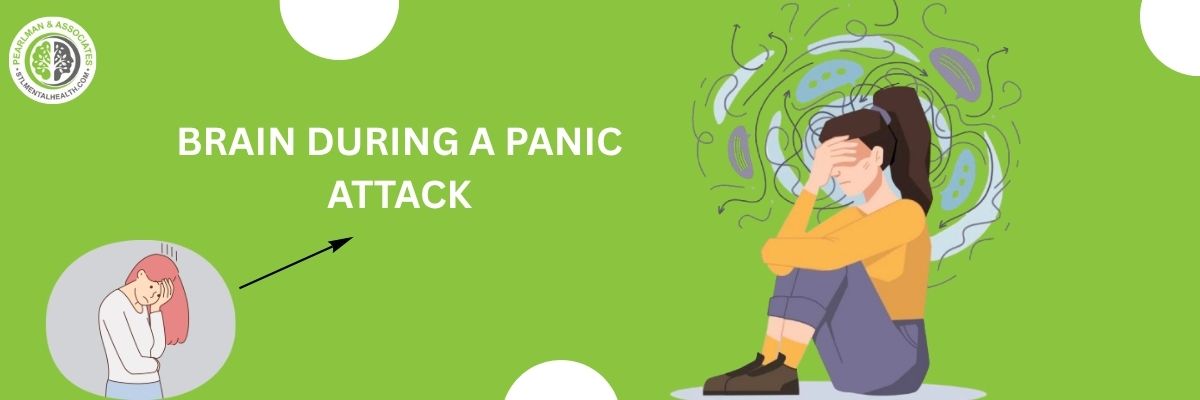
According to the DSM-5-TR, a panic attack is a sudden surge of intense fear that peaks within minutes and involves at least four physical or cognitive symptoms. It’s not a character flaw or overreaction, it’s an involuntary misfiring of a survival system that evolved over millions of years.
Around 11% of U.S. adults experience a panic attack in any given year, yet the majority are never formally diagnosed or treated.
of adults experience a panic attack each year
average time to reach peak intensity
of adults meet criteria for panic disorder
If these episodes happen repeatedly, it may be linked to panic disorder or chronic anxiety, where seeking stress therapy or a qualified therapist near me can make a real difference.
It follows a predictable neurological chain reaction, not chaos. This panic attack brain response is your body’s survival system activating at the wrong time.
Your amygdala, the brain’s threat-detection center, picks up a signal (a slightly faster heartbeat, a crowded room, or nothing you can identify) and marks it as danger before your conscious mind can evaluate it. In people prone to panic, this alarm is set too sensitive.
The amygdala signals the hypothalamus, which fires up your sympathetic nervous system within seconds. This is a survival circuit, it does not wait for your rational brain to weigh in.
Your adrenal glands release epinephrine (adrenaline) almost immediately. Heart rate spikes. Breathing accelerates. Blood shifts to your muscles.These are real physiological changes, which is exactly why panic attacks feel so real and dangerous.
Under peak stress, the prefrontal cortex, responsible for logic and context, is suppressed. This is why you cannot simply “think your way out” of a panic attack at its worst. The reasoning brain has been overridden by the survival brain.
Here’s the cruel part: the physical symptoms from Step 3, pounding heart, dizziness, and chest pain, are now re-read by your already-panicked amygdala as further proof of danger. The alarm amplifies itself.
Think of your amygdala as a smoke detector cranked to maximum sensitivity. It would rather trigger a hundred false alarms than miss one real fire. During a panic attack, it’s convinced you’re in danger even though you’re just making toast. The alarm is completely real. The fire is not.
A panic attack peaks within 10 minutes. The full episode, including the gradual drop in adrenaline, typically resolves within 20 to 30 minutes.
It cannot last indefinitely. The body’s stress response is physiologically self-limiting, and the parasympathetic nervous system will reassert itself.
Knowing this during an attack is one of the most powerful tools you have.
If chest pain radiates to your arm or jaw, is accompanied by nausea and cold sweats, and doesn’t improve, seek emergency care immediately. When in doubt, always get checked out.
These work by activating the parasympathetic nervous system to counteract the fight-or-flight response.
Extended exhales activate the vagus nerve, directly signaling the amygdala to stand down. This is your fastest physiological override.
[Inhale 4 sec, Hold 4 sec, exhale 6 sec]
Name 5 things you see, 4 you can touch, 3 you hear, 2 you smell, 1 you taste.This forces prefrontal cortex engagement and reduces brain during anxiety attack intensity.
Say to yourself, “This is a panic attack. My amygdala misfired. It will pass in under 30 minutes. I am not dying.” Labeling measurably reduces amygdala reactivity in neuroimaging studies.
If panic attacks are frequent, support matters. Many people benefit from therapy platforms like grow therapy or clinics such as Pearlman & Associates. You can also consider finding a therapist in St Louis or nearby professionals offering specialized stress therapy.
1. Can panic attack damage the brain?
A single panic attack does not damage brain tissue. However, chronic untreated panic disorder has been associated with amygdala sensitization and potential hippocampal changes from sustained cortisol exposure, both of which are reversible with evidence-based treatment.
2. Why do panic attacks feel like heart attacks?
Because the physiological symptoms are genuinely similar, racing heart, chest tightness, shortness of breath. Neuroimaging shows the brain activates the same threat-response regions during a panic attack as it would during an actual emergency. Your brain isn’t pretending. It’s wrong.
3. Why do panic attacks seem to come out of nowhere?
The amygdala processes threat signals before they reach conscious awareness. The alarm sounds before your reasoning brain has been consulted, so there’s genuinely no warning you can perceive. Triggers are often subtle internal sensations rather than external events.
4. Can panic attacks be treated effectively?
Yes. Cognitive Behavioural Therapy (CBT) shows remission rates of 70–90% for panic disorder in clinical studies. SSRIs and SNRIs are effective pharmacological options. Mindfulness-based approaches have also shown measurable neurological changes in amygdala reactivity.
Panic attacks may feel overwhelming, but once you understand what happens in the brain during a panic attack, they become a little less frightening.
Your brain is trying to protect you, it’s just overreacting.
With the right tools, awareness, and support, whether through therapy, lifestyle changes, or professional guidance, you can regain control.
And most importantly, you’re not alone in this.